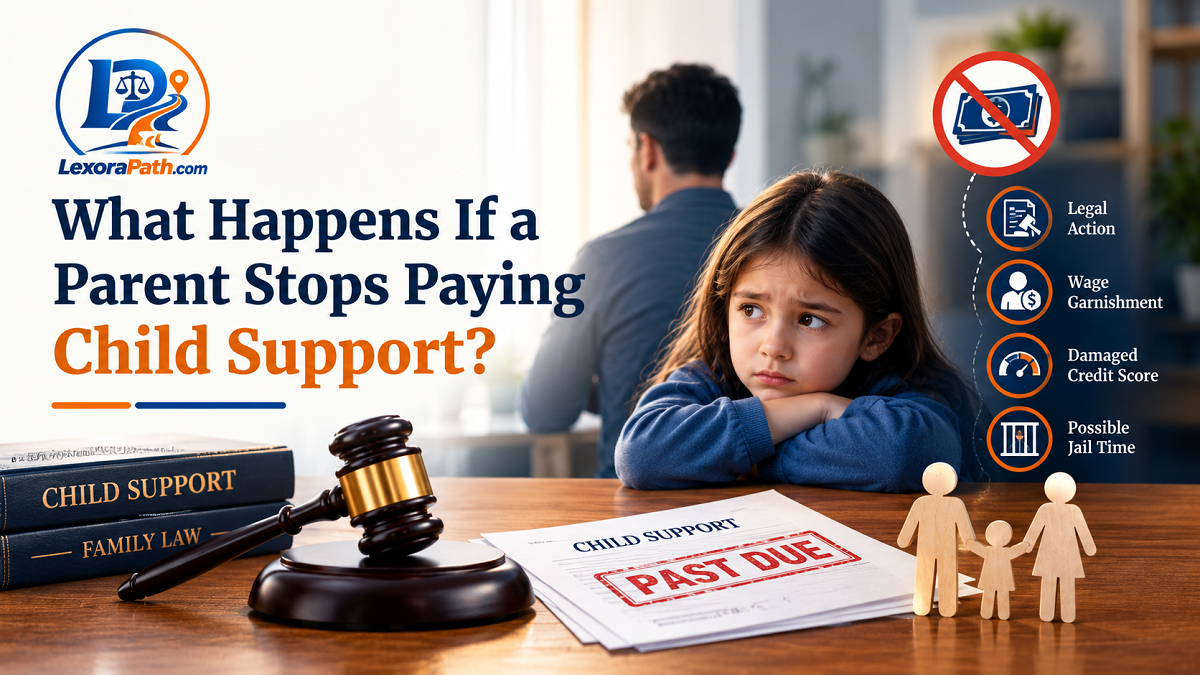
Raising a child costs money, and child support payments can help cover everyday expenses such as food, housing, clothing, education, and medical care. When a parent stops making court-ordered payments, the financial pressure can fall heavily on the parent who provides most of the child’s daily care.
But what happens when child support is not paid? Can the parent who owes money face legal consequences? Can unpaid payments be collected later? And what should someone do if they genuinely cannot afford the amount ordered by the court?
In the United States, failing to pay court-ordered child support can lead to several consequences, depending on the circumstances and the laws of the state involved. These may include unpaid balances, wage withholding, tax refund interception, license suspension, property liens, and court proceedings.
This guide explains what happens if a parent stops paying child support, how enforcement works, and what legal options may be available to both parents.
What Is Child Support?
Child support is financial assistance that one parent is legally required to provide toward the cost of raising a child. The obligation may be established through a court order or another legally recognized process.
Child support is intended to help meet a child’s needs. Depending on the applicable rules and order, it may contribute toward expenses such as:
- Food and groceries.
- Housing and household expenses.
- Clothing and personal necessities.
- School-related costs.
- Medical care and health insurance.
- Childcare and other eligible expenses.
In many cases, one parent pays support to the other parent, who provides most of the child’s daily care. However, the exact arrangement depends on the family circumstances and the applicable law.
Read Also: How Is Child Custody Decided in the United States?
Once a valid child support order is in place, the parent responsible for paying generally cannot simply stop making payments because of a disagreement with the other parent.
Even if the paying parent loses a job, experiences financial difficulties, or believes the amount is unfair, the existing order usually remains effective until it is changed or terminated through the proper legal process.
What Happens If a Parent Stops Paying Child Support?
When a parent misses child support payments, several things may happen. The outcome depends on the amount owed, the length of time payments have been missed, the state’s enforcement procedures, and whether the parent has a valid legal reason for requesting a change.
1. Unpaid Child Support Can Build Up
One of the first consequences is that the missed payments may become overdue child support, often called child support arrears.
For example, imagine a parent is ordered to pay $500 per month. If the parent misses four monthly payments, the unpaid amount would total $2,000, before any interest, fees, or other applicable charges.
The amount owed can continue to grow as additional payments become due.
Some states charge interest on overdue child support, while others apply different rules. The amount and treatment of arrears depend on the governing law and the details of the order.
Unpaid child support does not normally disappear simply because time passes. A parent should obtain an accurate payment history from the relevant child support agency or court rather than relying on informal calculations.
2. The State May Withhold Money From Wages
Wage withholding is a common child support enforcement method in the United States.
Under an income withholding order, the employer may be required to deduct child support from the paying parent’s wages and send the money through the appropriate payment system.
Depending on the circumstances and applicable rules, withholding may be used to collect ongoing support, overdue amounts, or both.
This can make payments more consistent and reduce the need for the parents to exchange money directly.
A parent who receives a wage withholding notice should read it carefully and follow the instructions. If the amount appears incorrect, the parent should contact the relevant agency or seek legal advice rather than ignoring the notice.
3. Tax Refunds May Be Intercepted
In eligible cases, a federal or state tax refund may be intercepted to help collect overdue child support.
This means a parent expecting a tax refund may receive less than expected, or may not receive the refund, because some or all of it is applied to qualifying child support debt.
Federal tax refund interception is subject to applicable program requirements and procedures. State tax refund programs may operate under their own rules.
The amount collected and how it is applied depend on the circumstances of the case.
Parents who believe a refund was intercepted incorrectly should contact the appropriate child support agency or tax authority to understand the reason and available procedures.
4. A Driver’s License or Professional License May Be Suspended
Some states allow certain licenses to be suspended when a parent fails to meet child support obligations.
Depending on state law, this may include a driver’s license, professional license, or another qualifying license.
For someone who depends on driving to get to work, losing a driver’s license can create additional financial problems. A professional license suspension may also affect the ability to earn income.
However, suspension is not automatic in every case. The rules, required notices, eligibility conditions, and possible ways to resolve the issue vary by jurisdiction.
If a parent receives a notice about a possible suspension, they should respond promptly and ask the agency about available options, including payment arrangements or other remedies permitted by law.
5. Property Liens May Be Placed on Certain Assets
In some circumstances, unpaid child support can result in a lien against property or other assets.
A lien is a legal claim that may affect the owner’s ability to sell, transfer, or refinance the property without addressing the debt.
Depending on state law, liens may apply to certain real estate or other property interests. The exact process and consequences differ by jurisdiction.
A lien does not necessarily mean the government immediately takes ownership of the property. It is a legal enforcement measure, and the rules governing its use and release depend on the case.
Parents who discover a child support lien should contact the relevant agency or a qualified attorney to understand the amount owed and the steps required to resolve the issue.
6. The Parent May Have to Attend a Court Hearing
When child support remains unpaid, the state agency or the other parent may ask the court to enforce the order.
A court may review the payment history, the reasons for nonpayment, and the parent’s ability to comply with the order.
Depending on the circumstances, the court may order payment of overdue amounts, establish a payment arrangement, or take other action permitted by law.
If a parent receives a court summons or enforcement notice, ignoring it can make the situation more difficult. The parent should read the documents carefully, meet deadlines, and attend required hearings.
If the parent has experienced a genuine financial hardship, supporting documents such as employment records, income statements, or medical information may be relevant to the issues before the court.
7. The Parent Could Face Contempt Proceedings or Jail in Some Cases
Failing to comply with a child support order can sometimes lead to contempt proceedings.
In certain circumstances, a court may impose penalties, including incarceration, if the legal requirements are satisfied. The procedures and standards depend on the type of proceeding and applicable law.
A person’s ability to pay can be an important issue in certain enforcement proceedings. Courts must follow the relevant legal requirements rather than treating every missed payment as an automatic reason for imprisonment.
Federal criminal prosecution is also possible in limited circumstances involving willful failure to pay qualifying child support obligations. These cases are not the ordinary way most unpaid child support matters are handled.
The U.S. Department of Justice explains that most child support enforcement matters are handled by state and local authorities, while federal prosecution applies in specific circumstances.
For these reasons, it is inaccurate to say that every parent who misses a payment will go to jail. However, deliberately ignoring a valid support obligation can create serious legal risks.
What If a Parent Cannot Afford to Pay Child Support?
Financial hardship can happen for many reasons. A parent may lose a job, become seriously ill, experience a reduction in income, or face another major change in circumstances.
If a parent genuinely cannot afford the current payment amount, the appropriate response is generally to seek a legal modification rather than simply stopping payments.
Request a Modification of the Child Support Order
A modification is a formal change to an existing support order.
Depending on state law, a parent may be able to request a modification when there has been a qualifying change in circumstances.
Examples may include:
- A substantial loss of income.
- Unemployment or a major reduction in working hours.
- A significant change in the child’s needs.
- A change in custody or parenting arrangements.
- A qualifying change in medical or financial circumstances.
Not every change will justify a modification. The court or agency must apply the rules governing the particular case.
Parents should contact their state child support agency or family court to learn how to request a review or modification.
Important: Do not assume that a modification request automatically pauses payments. Until the order is changed, the existing obligation generally remains in effect. In many situations, a later modification also does not erase arrears that have already accumulated.
Acting promptly can help a parent address the problem before the overdue balance grows further.
What Should You Do If the Other Parent Stops Paying Child Support?
If you are the parent who is supposed to receive support, missed payments can make it difficult to cover your child’s expenses.
There are practical steps you can take to address the situation.
Step 1: Review Your Child Support Order
Find your current child support order and review the amount due, payment schedule, and any relevant enforcement provisions.
Make sure you understand when payments are due and how they should be made.
Step 2: Keep Accurate Payment Records
Maintain a record of payments received and missed payments.
Save relevant bank statements, official payment histories, notices, and communications. If payments are processed through a state agency, request an official account statement when needed.
Accurate records can help the agency determine whether a balance is overdue and what enforcement options may be available.
Step 3: Contact Your State Child Support Agency
State and local agencies generally handle the routine enforcement of child support orders.
The agency may help review the payment history, explain enforcement options, and take appropriate steps to collect support under applicable law.
You can begin by visiting the official USA.gov child support resource, which explains how to find state or tribal child support services.
You do not necessarily need to hire a private attorney before contacting the agency.
Step 4: Ask About Available Enforcement Options
Depending on your case, possible enforcement measures may include wage withholding, tax refund interception, license-related actions, liens, or court proceedings.
Not every option is available in every case, and some require specific legal conditions to be met.
Ask the agency which measures may apply to your situation and whether additional documents are needed.
Step 5: Seek Legal Advice if Necessary
If the agency cannot resolve the issue, the other parent is concealing income or assets, or the case involves multiple states, you may benefit from speaking with a family law attorney.
If you cannot afford legal representation, ask about legal aid organizations or court self-help resources in your area.
What If the Paying Parent Lives in Another State?
Child support enforcement can become more complicated when the parents live in different states.
However, living in another state does not automatically eliminate a parent’s child support obligation.
State and federal systems provide procedures for establishing, enforcing, and modifying qualifying support orders across state lines.
If the parent responsible for paying has moved, the receiving parent should contact their state child support agency. The agency can explain how to pursue the case and whether coordination with another state is necessary.
The official USA.gov child support guide provides information about finding state or tribal agencies and obtaining help when a parent lives elsewhere.
Do not assume you must personally travel to the other state before seeking assistance.
Can Parents Make a Private Agreement to Stop Child Support?
Parents may discuss financial arrangements, but a private agreement does not necessarily change a valid court order.
For example, one parent might tell the other parent that payments can stop temporarily. Even if both parents agree, the existing order may continue to apply until it is legally modified or terminated.
A parent should not rely on a verbal promise or informal text message as a substitute for a court-approved change when one is required.
If both parents believe the current arrangement should change, they should check the relevant state procedure for modifying the order.
This can help prevent future disputes about the amount owed and whether payments were legally required.
Does Child Support Debt Ever Go Away?
The treatment of unpaid child support depends on state law and the circumstances of the case.
In many situations, overdue support remains legally collectible even after the child reaches adulthood. However, the applicable rules governing enforcement periods, interest, and collection methods vary.
A parent’s obligation may also depend on the terms of the original order, including when support ends and whether additional expenses are covered.
Do not assume that the debt automatically disappears when a child turns 18, when a parent moves away, or when the parents stop communicating.
If the balance appears incorrect or the debt is old, request an official accounting from the agency responsible for the case. A qualified attorney can explain whether any legal defenses or limits on collection may apply.
Frequently Asked Questions
1. Can a parent go to jail for not paying child support?
In some cases, yes. A court may impose incarceration in qualifying enforcement or contempt proceedings, and federal prosecution is possible in limited circumstances. However, jail is not an automatic consequence of every missed payment.
2. Can unpaid child support affect a credit report?
Depending on applicable law and reporting practices, qualifying unpaid child support debt may be reported to credit reporting agencies. If you believe the information is inaccurate, contact the reporting agency and the relevant child support authority to understand the dispute process.
3. Can a parent stop paying child support after losing a job?
Losing a job does not automatically cancel an existing support order. The parent should promptly ask the court or state agency about requesting a modification and continue complying with the existing order to the extent legally required while the request is considered.
4. Can the receiving parent refuse visitation because child support was not paid?
Child support and parenting time are generally treated as separate legal obligations. A parent should not assume that missed payments automatically permit them to disregard a custody or parenting-time order. If safety is a concern, seek appropriate legal protection.
5. What happens if a parent ignores child support notices?
Ignoring notices can lead to missed deadlines, additional enforcement actions, and court complications. The parent should respond promptly, review the documents, and seek legal advice if they do not understand what is required.
6. Can I collect unpaid child support without hiring a lawyer?
In many cases, you can begin by contacting your state child support agency. These agencies provide enforcement services under applicable rules. A lawyer may still be helpful in complicated cases involving disputed balances, interstate issues, or other legal concerns.
7. Does moving to another state eliminate child support debt?
No. Moving does not automatically cancel an existing support obligation. Interstate enforcement procedures may allow the responsible authorities to pursue qualifying unpaid support across state lines.
Final Thoughts
When a parent stops paying child support, the consequences can extend beyond the immediate financial problem. Unpaid balances may accumulate, and the responsible parent may face wage withholding, tax refund interception, liens, license-related consequences, or court proceedings, depending on the circumstances and applicable law.
At the same time, a parent experiencing genuine financial hardship should not assume that there is no legal solution. Requesting a modification through the proper process may be an option when circumstances have substantially changed.
If you are owed child support, keep accurate records and contact your state child support agency to understand the available enforcement options. If you are the parent who owes support, respond to notices promptly and seek guidance before the situation becomes more serious.
The most important step is to understand your rights and responsibilities under the child support order and the laws of your state.
Legal Disclaimer: This article is for general educational purposes only and is not legal advice. Child support laws, enforcement procedures, and penalties vary by state and may change. The information provided does not create an attorney-client relationship. For guidance about your specific circumstances, consult your state child support agency, official court resources, or a qualified family law attorney.