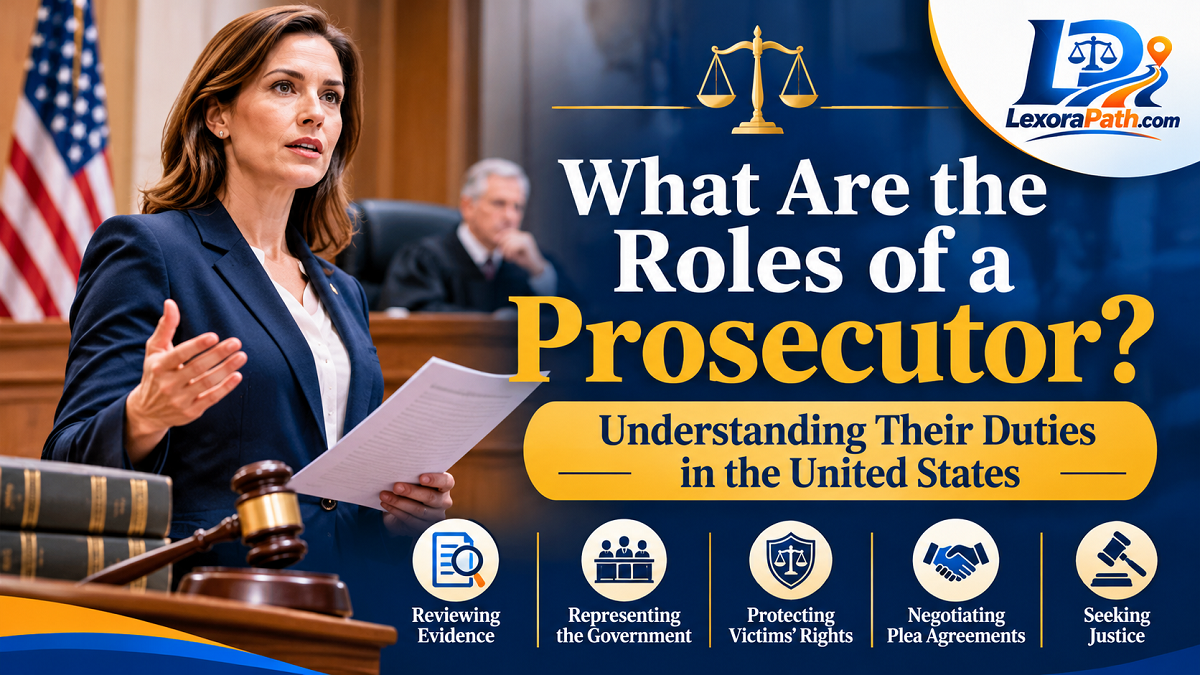
When someone is accused of committing a crime in the United States, several legal professionals may become involved in the criminal justice process. One of the most important is the prosecutor. Prosecutors play a central role in deciding whether criminal charges should be filed, presenting evidence in court, and ensuring that criminal cases are handled according to the law.
But what are the roles of a prosecutor, and how do they influence the outcome of a criminal case?
A prosecutor is a government attorney responsible for representing the public in criminal proceedings. Their job is not simply to obtain convictions. They also have a professional responsibility to pursue justice, respect the rights of defendants, and ensure that legal proceedings are conducted fairly.
Read Also: When Should You Contact a Lawyer After an Accident?
Understanding the responsibilities of a prosecutor can help defendants, crime victims, witnesses, and ordinary citizens better understand how the American criminal justice system works.
What Is a Prosecutor?
A prosecutor is a licensed attorney who represents the government in criminal cases. Depending on the jurisdiction, prosecutors may work for a local district attorney’s office, a county prosecutor’s office, a state attorney general’s office, or the federal government.
At the local and state levels, prosecutors commonly handle cases involving theft, assault, burglary, domestic violence, drug-related offenses, and other violations of state criminal laws.
At the federal level, prosecutors represent the United States government in cases involving federal offenses, such as certain fraud schemes, federal drug crimes, tax violations, and other crimes under federal law.
Federal prosecutors are generally known as Assistant United States Attorneys (AUSAs). They work within U.S. Attorney’s Offices under the Department of Justice.
Although their specific responsibilities may differ depending on the jurisdiction, their central purpose is to enforce criminal laws while protecting the integrity of the justice system.
What Are the Main Roles of a Prosecutor?
Prosecutors perform several important duties throughout a criminal case. Their involvement can begin before formal charges are filed and continue through trial, sentencing, and sometimes appeals.
1. Reviewing Evidence and Deciding Whether to File Charges
One of the most important responsibilities of a prosecutor is evaluating the available evidence before deciding whether criminal charges are appropriate.
Police officers and other law enforcement agencies generally investigate suspected criminal activity. After gathering evidence, they may submit reports and supporting materials to the prosecutor for review.
The prosecutor examines information such as:
- Police reports and investigative records
- Witness statements and interviews
- Photographs and video recordings
- Physical and forensic evidence
- Medical records when relevant
- Other documents connected to the alleged offense
Based on the applicable law and available evidence, the prosecutor determines whether there is a sufficient legal and factual basis to move forward with charges.
Not every arrest results in criminal prosecution. A prosecutor may decline to file charges when the evidence is insufficient or other legal considerations make prosecution inappropriate.
2. Representing the Government in Court
Another major role of a prosecutor is representing the government during criminal court proceedings.
During hearings and trials, prosecutors present the government’s position, explain the applicable criminal laws, and introduce evidence supporting the charges.
Their courtroom responsibilities may include:
- Presenting opening statements
- Calling witnesses to testify
- Introducing admissible evidence
- Questioning witnesses
- Responding to legal arguments from defense attorneys
- Making closing arguments
The prosecutor must follow court rules and applicable laws throughout the proceedings.
Importantly, the prosecution has the burden of proving the defendant’s guilt beyond a reasonable doubt in a criminal trial. The defendant is not required to prove their innocence.
3. Protecting the Rights of Crime Victims
Prosecutors also play an important role in communicating with crime victims and helping them understand the criminal justice process.
Although prosecutors represent the government rather than acting as the victim’s personal attorney, they may provide information about court dates, explain important case developments, and communicate with victims about relevant proceedings.
Under the federal Crime Victims’ Rights Act, eligible victims of federal crimes have specific rights, including:
- The right to reasonable protection from the accused
- The right to timely notice of public court proceedings
- The right to be reasonably heard at certain proceedings
- The right to confer with the government attorney handling the case
- The right to proceedings free from unreasonable delay
- The right to fairness and respect for their dignity and privacy
State laws may provide additional protections for crime victims.
4. Preparing and Presenting Evidence at Trial
Preparing a criminal case requires careful examination of the available facts and evidence.
Prosecutors review investigative reports, evaluate witness statements, identify potential weaknesses in the case, and determine which evidence may be presented in court.
They may also prepare witnesses for courtroom procedures and organize exhibits, documents, and other supporting materials.
However, prosecutors must follow legal disclosure requirements. They cannot simply present evidence that supports the government’s position while ignoring important information that may help the defendant.
For example, prosecutors have constitutional obligations to disclose material exculpatory evidence to the defense. Such evidence may support the defendant’s innocence or affect the credibility of a witness.
This responsibility is essential to maintaining a fair criminal justice system.
5. Negotiating Plea Agreements
Not every criminal case proceeds to a full trial. In many situations, prosecutors and defense attorneys discuss a possible plea agreement.
A plea agreement is an arrangement in which a defendant agrees to plead guilty, often in exchange for certain concessions from the prosecution.
Depending on the case and applicable law, an agreement may involve:
- Reducing the severity of criminal charges
- Dismissing certain charges
- Recommending a particular sentencing outcome
- Resolving multiple criminal allegations through one agreement
Prosecutors must consider the facts, seriousness of the offense, available evidence, and interests of justice when evaluating a proposed agreement.
A defendant should understand the consequences of any guilty plea before accepting an agreement. A defense attorney can explain the potential legal consequences and available options.
6. Recommending Sentences
When a defendant is convicted or enters a guilty plea, the case may proceed to sentencing.
Prosecutors can present arguments about the appropriate sentence based on the nature of the offense, the defendant’s criminal history, the harm caused, and other relevant factors.
They may also present information about the impact of the crime on victims.
However, the prosecutor does not independently decide the final sentence. That responsibility generally belongs to the judge, who considers applicable sentencing laws, guidelines, and relevant circumstances.
The prosecutor’s recommendation is one part of the sentencing process.
7. Handling Appeals and Other Legal Proceedings
A prosecutor’s responsibilities may continue even after a criminal trial ends.
If a defendant challenges a conviction or sentence, government attorneys may represent the prosecution in appellate proceedings.
During an appeal, prosecutors respond to legal arguments raised by the defense and explain why the lower court’s decision should be upheld, when appropriate.
They may also review legal issues that arise after conviction and respond to requests for post-conviction relief.
These responsibilities help ensure that criminal cases comply with applicable legal requirements at different stages of the judicial process.
What Is the Difference Between a Prosecutor and a Defense Attorney?
Although prosecutors and defense attorneys both work within the criminal justice system, they have different responsibilities.
A prosecutor represents the government and presents the case against someone accused of a crime. A defense attorney represents the accused person and protects their legal and constitutional rights.
Here are some important differences:
| Prosecutor | Defense Attorney |
|---|---|
| Represents the government | Represents the defendant |
| Reviews evidence for prosecution | Examines evidence to defend the accused |
| Presents the government’s case | Challenges the prosecution’s case |
| May negotiate plea agreements | Advises clients about plea agreements |
| May recommend a sentence | Advocates for the defendant during sentencing |
| Must pursue justice within the law | Must protect the client’s legal rights |
Both professionals have important roles in ensuring that criminal proceedings follow the law.
Does a Prosecutor Represent the Crime Victim?
This is a common question, especially among people involved in criminal cases.
A prosecutor does not generally serve as the personal attorney for a crime victim. Instead, the prosecutor represents the government and the public interest.
Although prosecutors may communicate with victims, explain court procedures, and consider their concerns, they do not necessarily have to follow every request made by a victim.
For example, a victim may want criminal charges filed, but the prosecutor must independently evaluate the evidence and applicable law before deciding how to proceed.
Victims who need personal legal advice about compensation, civil claims, or other individual legal rights may benefit from consulting a private attorney.
What Qualities Make an Effective Prosecutor?
Being a prosecutor requires more than understanding criminal laws. These professionals must make important decisions that can affect individuals, families, and communities.
Some valuable qualities include:
Strong legal knowledge: Prosecutors need a thorough understanding of criminal statutes, court procedures, constitutional protections, and evidence rules.
Analytical thinking: They must evaluate complicated facts, identify relevant evidence, and determine whether criminal charges are legally supported.
Communication skills: Prosecutors regularly communicate with judges, defense attorneys, witnesses, victims, law enforcement officers, and juries.
Ethical judgment: They must act honestly, disclose required information, and avoid pursuing convictions through improper methods.
Professional responsibility: Prosecutors should understand that their decisions carry significant consequences and must be guided by fairness and the law.
Frequently Asked Questions About the Roles of a Prosecutor
1. What is the main responsibility of a prosecutor?
The main responsibility of a prosecutor is to represent the government in criminal proceedings and seek justice within the law. This includes evaluating evidence, making charging decisions, presenting cases in court, and respecting the legal rights of everyone involved.
2. Can a prosecutor drop criminal charges?
Yes. Depending on the jurisdiction and applicable procedures, a prosecutor may decide to dismiss or withdraw criminal charges when legally appropriate. In some situations, court approval is required.
3. Does a prosecutor work with the police?
Yes. Prosecutors frequently work with law enforcement agencies during criminal investigations and case preparation. However, police generally conduct the investigation, while prosecutors make legal decisions about criminal prosecution.
4. Can a prosecutor represent a victim in court?
A prosecutor represents the government, not the victim as a private client. However, prosecutors may communicate with victims, explain court proceedings, and help ensure that applicable victims’ rights are respected.
5. Who decides whether a defendant is guilty?
In a criminal trial, a jury generally determines whether the prosecution has proved guilt beyond a reasonable doubt. In a bench trial, the judge makes that determination. The prosecutor presents the government’s case but does not independently decide guilt.
6. Do prosecutors have to disclose evidence that helps the defendant?
Yes. Prosecutors have legal and constitutional disclosure obligations, including the duty to disclose material exculpatory evidence. Failing to meet applicable disclosure requirements can create serious legal consequences.
Final Thoughts
Understanding what are the roles of a prosecutor provides valuable insight into how the criminal justice system operates in the United States. From reviewing evidence and deciding whether to file charges to presenting cases in court and participating in sentencing proceedings, prosecutors have responsibilities at nearly every stage of a criminal case.
Their role extends beyond securing convictions. They must respect constitutional protections, consider victims’ rights, follow ethical standards, and make decisions based on the law and available evidence.
Whether you are a crime victim, a defendant, a witness, or simply interested in understanding the American legal system, knowing how prosecutors work can help you better understand the criminal justice process.
Disclaimer: This article is for general informational and educational purposes only. It does not constitute legal advice or create an attorney-client relationship. Criminal laws and prosecutorial procedures can vary by state and federal jurisdiction. Consult a qualified attorney for advice about a specific legal matter.

Emily Carter is a lawyer with over 12 years of experience in the legal field. She has a strong understanding of various areas of U.S. law, including family law, personal injury, criminal defense, and estate planning. She is passionate about making legal information simple and easy to understand. Through her contributions to LexoraPath, she helps readers learn about their legal rights, understand important legal matters, and make informed decisions.